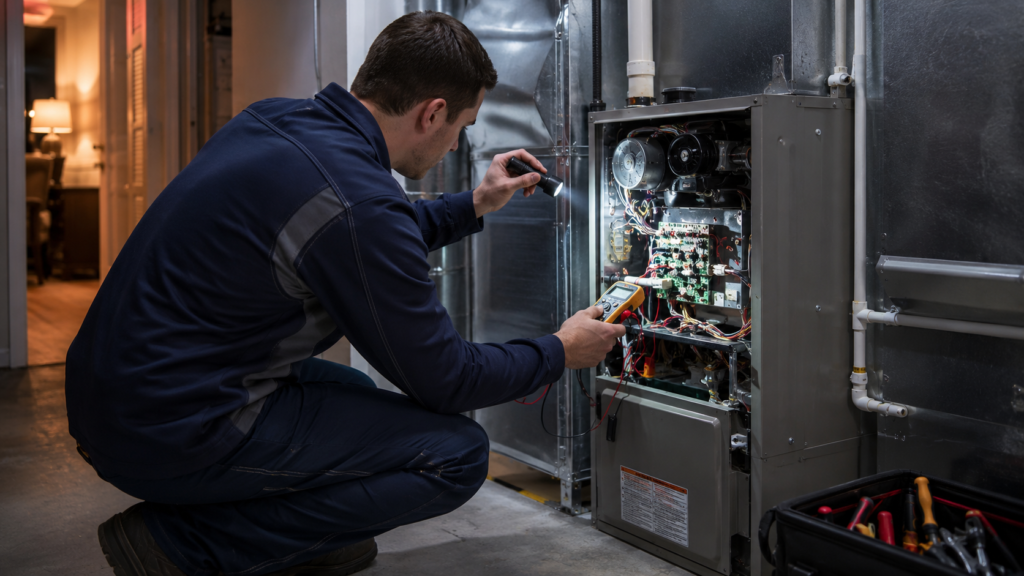
Fort Worth winters may be short compared to other parts of the country, but when the cold snaps hit, you need your furnace working – not sputtering, cycling on and off, or blowing cold air at 2am. Because our winters are mild, many Fort Worth homeowners don’t think about furnace maintenance the way they think about ac repair, which means small furnace issues often go unnoticed until the first real cold front, when the whole system finally gives out.
Below, we break down the most common furnace problems we see across Fort Worth and the surrounding area, what you can safely check yourself, and when it’s time to bring in a licensed technician.
Poor Airflow in Your House? Here’s Why
If you’re noticing poor airflow in your house in Fort Worth, it’s often a sign your furnace filter is clogged, ductwork is blocked, or the blower motor is struggling. Left alone, weak airflow tends to get worse – and can mean your heater isn’t working as hard as it should, or stops working altogether.
1. Furnace Won’t Turn On At All
If your furnace is completely unresponsive, start with the basics: check your thermostat batteries and settings, and confirm the breaker hasn’t tripped. If those check out, the issue is likely with the ignition system, control board, or a safety switch that’s preventing the unit from starting. A furnace that won’t fire up at all is one of the most common reasons homeowners call for emergency AC repair service – the same rapid-response team handles heating emergencies too.
2. Furnace Runs But Doesn’t Heat
A furnace that runs constantly but never actually warms the house usually points to one of two things: a failing heat exchanger or a burner that isn’t igniting properly. This isn’t something to troubleshoot yourself – a cracked heat exchanger can be a safety hazard, and diagnosing it requires professional equipment.
3. Weak or No Airflow From Vents
Weak airflow is often blamed on the furnace itself, but it’s frequently a blower motor issue. If your blower motor is struggling, airflow throughout the whole house drops, even if the furnace is heating properly. Our blower motor replacement service resolves this quickly and is one of the most common furnace repairs we perform in Fort Worth homes.
4. Furnace Short-Cycles (Turns On and Off Repeatedly)
Short cycling – where the furnace kicks on for a few minutes and then shuts off before actually heating the space – usually points to a dirty air filter, a failing thermostat, or an overheating limit switch. Start by checking your filter, since a clogged one is the single most common cause. If replacing the filter doesn’t fix it, the issue is likely electrical or thermostat-related, which our thermostat replacement service can diagnose and resolve.
5. Strange Noises: Banging, Rattling, or Squealing
A little operational noise is normal, but banging, rattling, or high-pitched squealing usually means something mechanical needs attention. Squealing is often a belt or motor bearing issue, while banging can indicate a delayed ignition – both of which should be inspected quickly. Our motor bearing lubrication service resolves the most common squealing culprit before it turns into a full motor failure.
6. Thermostat Isn’t Communicating With the Furnace
If your thermostat display is on but the furnace never responds, the problem is often a wiring or communication issue between the two, especially after a smart thermostat installation or a power outage. This is a quick fix for a professional but frustrating to chase down yourself. If you’re considering upgrading, our smart thermostat setup service ensures your new thermostat is properly paired and calibrated with your existing furnace.
7. Pilot Light Won’t Stay Lit (Older Systems)
Older furnaces with a standing pilot light can experience a flame that won’t stay lit, usually due to a dirty or failing thermocouple, a draft near the pilot assembly, or a gas supply issue. Never attempt to bypass a safety mechanism on a gas furnace – if your pilot light keeps going out, it’s protecting you from a bigger issue and needs professional attention.
8. Control Board Issues on Newer Systems
Modern furnaces rely on an electronic control board to manage ignition timing, blower operation, and safety shutoffs. When this board fails or develops a fault, you may see error codes flashing on the unit or experience random shutdowns. Our control board repair service diagnoses and resolves these electronic faults, which are becoming more common as more Fort Worth homes upgrade to newer, smarter HVAC systems.
9. Uneven Heating Throughout the House
If some rooms are warm while others stay cold, the issue is often related to ductwork, not the furnace itself – leaky, blocked, or poorly sealed vents can starve certain rooms of airflow. Our ventilation system repair service identifies and fixes the airflow imbalances causing uneven heating across your home.
10. Rising Energy Bills With No Change in Usage
If your heating bills are climbing but your habits haven’t changed, your furnace is likely working harder than it should to produce the same amount of heat – a sign of declining efficiency. An energy efficiency audit can pinpoint exactly where your system is losing performance, whether that’s the furnace itself, insulation, or ductwork.
Why a Furnace Tune Up Matters
A furnace tune up catches small problems – worn parts, dirty burners, loose electrical connections – before they turn into a heater isn’t working situation in the middle of winter. Regular furnace maintenance and a yearly furnace inspection are the easiest way to avoid an emergency repair call.
DIY vs. Calling a Professional
A few furnace issues are genuinely safe to check yourself: your thermostat settings, air filter condition, and breaker panel. Beyond that, furnace repair involves gas lines, electrical components, and combustion safety systems that should always be handled by a licensed technician. Attempting to fix ignition, gas, or control board issues yourself isn’t just risky for the equipment – it’s a genuine safety hazard for your household.
Why Fort Worth Homes Need Furnace Attention Before Winter Hits
Because our heating season is short, furnaces here often sit unused for eight or nine months at a time. That extended downtime is exactly when dust builds up, parts seize, and small issues go undetected – so when the first cold front rolls through, the furnace is asked to perform at full capacity with no warning. A preventive maintenance plan catches these issues in the fall before you’re stuck without heat on a 35-degree night, and routine seasonal service through our routine AC maintenance plans covers your heating system alongside your cooling system year-round.
If you’re weighing whether it’s time to repair or simply replace an aging unit, our guide on common AC problems for Fort Worth homeowners covers the same repair-vs-replace decision points that apply to furnaces, and our ultimate guide to AC maintenance in hot Fort Worth weather is a useful companion piece for keeping your whole HVAC system running efficiently in every season.
Furnace Repair Across the Fort Worth Area
We provide furnace and full HVAC repair service throughout Fort Worth and the surrounding communities, including Azle, Eastland, Grapevine, Euless, North Richland Hills, Benbrook, and Arlington Heights. Wherever you’re located, our licensed technicians can be on-site quickly to diagnose the problem and get your heat back on.
Don’t Wait for the Next Cold Front
A furnace problem rarely fixes itself, and small issues like a struggling blower motor or a failing control board only get more expensive to repair the longer they’re ignored. If your furnace is acting up – or it’s been a while since your last tune-up – now is the time to get it checked.
Contact our team today to schedule a furnace inspection or repair, and head into winter with confidence that your heat will actually work when you need it.
Frequently Asked Questions
How often should I have my furnace serviced if I barely use it?
Even a furnace that only runs a few months a year benefits from annual service. The parts inside don’t just wear from use – they can also seize, corrode, or accumulate dust during long periods of inactivity, which is exactly why so many furnace failures in Fort Worth happen on the very first cold day of the season.
Is it normal for my furnace to smell strange when I first turn it on for the season?
A brief, mild dusty smell in the first few minutes is common and usually just burning off dust that settled over the summer. However, a persistent burning smell, a strong gas odor, or anything sharp and chemical should be treated as a warning sign – turn the system off and call a technician right away.
Can I replace my furnace filter myself, or does it require a professional?
Replacing a standard furnace filter is one of the few furnace tasks that’s genuinely safe and easy to do yourself, typically every one to three months depending on the filter type. If you’re not sure what size or type your system needs, we’re happy to point you in the right direction during a routine visit.
How do I know if I need a furnace repair or a full replacement?
As a general rule, if your furnace is under 10–15 years old and the repair cost is reasonable, repair is usually the better value. Older systems with recurring issues, declining efficiency, or a cracked heat exchanger are often better candidates for replacement. A technician can walk you through the real cost comparison for your specific unit.
Do you offer emergency furnace repair, or only AC emergencies?
Our emergency response team handles both heating and cooling failures. If your furnace goes out unexpectedly, especially overnight or during a cold snap, the same rapid-response process used for AC emergencies applies to furnace breakdowns as well.
Leave a Reply